Respiratory Virus Trends 2023-24 The County of San Luis Obispo (SLO) Public Health Laboratory actively monitors influenza and SARS-COV-2 circulation as part of our respiratory virus surveillance activities. Respiratory illnesses are on an upward trend, based on recent test requests and positivity rates. As Dr Beebe liked to quip, “Tis the season to be sneezing.” - Influenza: In the 2023-24 season to date, influenza A is the most common influenza type, accounting for 80% of all influenza detections. Of these, 83% have been subtyped as influenza A H1N1 and 17% as seasonal influenza A H3.
- SARS-CoV-2: The variant showing the greatest increase in the county, state, and nation is the JN.1 variant. Sequencing analyses in December showed that JN.1 was detected in 38.7% of SARS-CoV-2 specimens from SLO. This variant is contributing to increased hospitalizations nationwide due to its high transmissibility rate.
Thank you to the clinics and hospitals that submit respiratory samples and contribute to our understanding of respiratory patterns in SLO County! 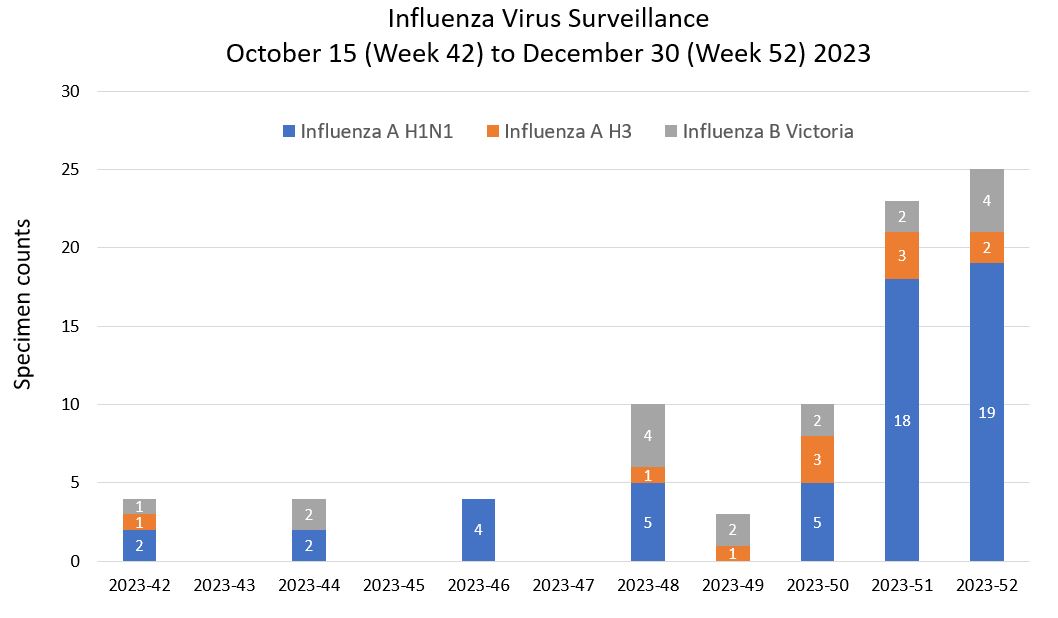 Rabies Surveillance In 2023, the SLO Public Health Laboratory, in conjunction with Pacific Wildlife Care, evaluated 66 animals for rabies, a potentially fatal viral disease of the central nervous system. The animals tested were 27 dogs, 16 cats, 16 bats, 3 raccoons, 2 skunks, 1 wild rat, and 1 ground squirrel. The only animal testing positive for rabies was a bat, which serves as a good reminder to avoid touching or handling these winged mammals! 
Blood Lead Testing Spotlight The California Department of Public Health’s (CDPH) Childhood Lead Poisoning Prevention Branch relies on healthcare providers to regularly assess and screen California’s children for lead exposure. A recent lead poisoning outbreak linked to cinnamon applesauce pouches highlights the importance of blood lead monitoring (http://tinyurl.com/59tdh9bd). - Blood lead testing requirements
- A child should be tested at both 12 and 24 months if:
- The are in a publicly funded program for low-income children
- They live or spend a lot of time in a dwelling built before 1978 that has peeled or chipped paint or has been recently remodeled
The SLO Public Health Laboratory offers blood lead testing to screen for the presence of lead in fingerstick specimens. For additional details on this and other tests, refer to: www.slocounty.ca.gov/Laboratory. MALDI-TOF Mass Spectrometry Update The SLO Public Health Laboratory is now using a MALDI-TOF mass spectrometry instrument to identify mycobacteria species, including Mycobacterium tuberculosis. Further testing is underway to validate the identification of molds including Coccidioides immitis, the cause of Valley Fever.
Questions? Please contact the Laboratory Director by email or phone. Glen M. Miller, PhD, HCLD(ABB) Director, Public Health Laboratory San Luis Obispo County Public Health Laboratory 2191 Johnson Avenue, San Luis Obispo, CA 93401 (805) 781-5512 [email protected] |  County of San Luis Obispo