Why You Can Be Confident in the Security of SLO County’s November Election
Author: Erin Clausen
Date: 9/9/2026 12:10 PM
The SLO County Elections Office provides an overview of the processes and safeguards that will ensure ballot security during the upcoming November 3 General Election.
There is a lot of talk about elections right now. News reports, lawsuits, court decisions, and social media posts may leave voters wondering what all of it means for the November 3 General Election here in San Luis Obispo County.
The most important thing for local voters to know is this: SLO County Elections is preparing to conduct the election under California law, with multiple safeguards in place to protect ballots and verify the accuracy of the results. In fact, election security does not depend on any one person, machine, or procedure; it is built in layers. If one safeguard were to fail, others are there to detect a problem.
Here are some of the most important protections.
Your vote exists on paper
Every vote cast in SLO County produces a paper ballot. That matters because the official election record does not exist only inside a computer. The paper ballots can be reviewed and counted by people if there is ever a question about the electronic count.
California requires every ballot to be paper or to have a voter-verifiable paper record.
The system that counts your ballot is not connected to the internet. California law prohibits voting systems from being connected to the internet or from electronically sending or receiving election data through an outside network.
California’s voting systems and tabulators do not contain modems or other hardware that could be remotely activated. That means someone sitting somewhere else cannot simply log onto the internet and change SLO County’s vote totals.
Voting equipment must pass extensive testing
Counties cannot simply choose any equipment or software they want to count votes.
Before a voting system can be used in California, the Secretary of State must review and approve it. State testing includes reviewing the system’s source code, security testing, attempts by experts to penetrate the system, and testing under election-like conditions.
There is also another check before each election. As required by law, SLO County conducts Logic & Accuracy Testing, often called L&A testing. During this process, staff run test ballots with known votes through the equipment and confirm that the machines report the expected results. For the November 3 election, SLO County’s public Logic & Accuracy Testing is scheduled to begin September 30 at 10 a.m. (You are invited and welcome to attend.)
Before every election, counties must also verify that their voting system software matches the version approved and supplied by the California Secretary of State. Think of this as checking the software’s unique digital fingerprint to make sure it has not been changed.
Ballots don’t simply move from place to place without controls
Physical security is an important part of election security, too. Election officials use procedures to track and protect ballots as they are collected, transported, processed, counted, and stored. California’s election procedures include requirements for sealed ballot containers, tamper-evident seals, and documented chain of custody.
These safeguards are designed to make sure ballots are accounted for throughout the process and to make unauthorized access detectable.
Vote-by-Mail ballots go through verification before they are counted
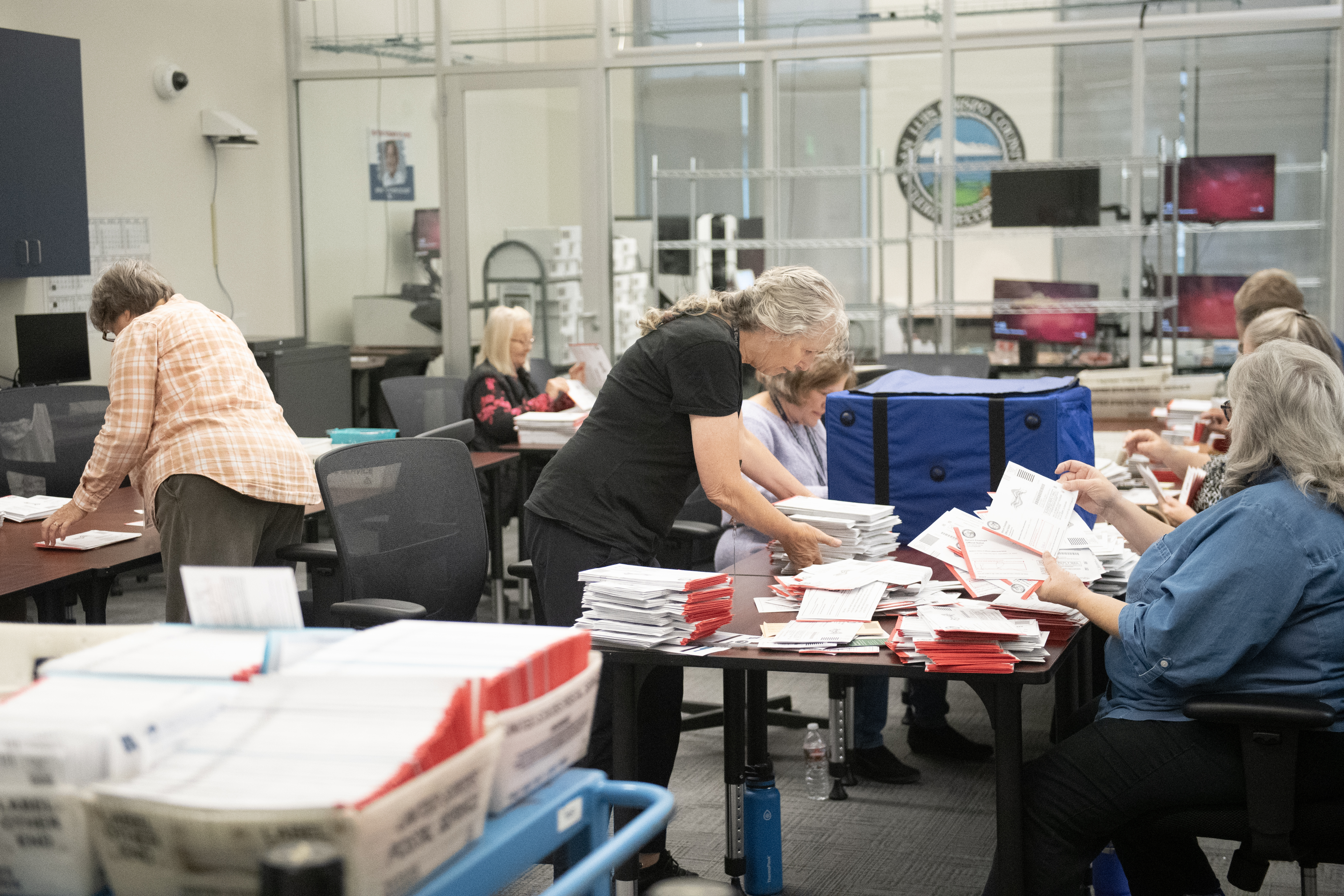
A ballot returned by mail or drop box does not simply arrive at the Elections Office and go straight into a counting machine. Before the ballot can be counted, trained election workers process the return envelope and verify the voter’s signature under California law.
If a ballot envelope is unsigned or the signature does not compare with signatures in the voter’s record, the voter may be contacted and given an opportunity to correct, or “cure,” the issue. Only after the ballot has passed the required checks can it move forward to be counted.
The computer count is checked by people
Election security does not end when ballots have been run through the tabulators. After the election, California requires counties to conduct a manual tally. Election workers physically examine and hand-count ballots from randomly selected precincts and compare that count with the results produced by the voting system. SLO County’s public 1% Manual Tally for the November election is scheduled to begin November 18 at 9 a.m. (Again, you are invited and welcome to attend.)
This is an important safeguard: The electronic results are checked against the actual paper ballots. Results for an election are not official and cannot be certified until they are confirmed.
You don’t have to take our word for it
Many parts of the election process are open to public observation. Members of the public may observe activities including voting equipment testing, Vote-by-Mail processing, Election Day operations, and the post-election canvass, subject to rules that protect voters, ballots, and election workers. Observers can watch how Vote-by-Mail envelopes and ballots are handled and counted. They cannot touch ballots or interfere with the work. (If you are interested but cannot get here to watch yourself, we have a video that covers many of the steps.)
We welcome that transparency. Confidence in elections should be based on processes people can examine, not simply assurances from election officials.
What about all the court cases and election-related news?
There are real legal disputes taking place around elections in 2026, including lawsuits involving mail voting, voter registration records, and election administration. Some of those cases could possibly affect election rules or deadlines.
SLO County Elections is monitoring developments that could affect local voters and will follow the law in effect for the November 3 General Election. But a lawsuit, political disagreement, or claim on social media does not by itself mean that SLO County’s voting system or ballots are unsafe.
The safeguards described above—paper ballots, certified equipment, pre-election testing, physical security, chain-of-custody procedures, public observation, and post-election hand counting—remain part of how we protect the election.
Security also means getting it right, not getting it fast
Election Night results are not final results. The first results posted at 8pm are all mail ballots received and counted before Election Day, followed by all ballots cast by voters who checked in at their polling location that day. Those updates are posted at least every two hours until the last ballot cast at a poll has been counted and added to the unofficial running total.
Thousands of ballots, including mail ballots cast in their return envelope by the state's deadline, may still need to be received, signature-verified, processed, and counted after Election Day. Election officials in every California county also complete required checks before the election can be certified. That part takes time, though a new law requires that the bulk of the counting is complete within 13 days.
A changing vote total after Election Night does not mean votes are being changed. In most cases, it means additional valid ballots are being processed and added to the count. Our priority is not to be first but to get the count right.
Trust, but verify
We understand why voters ask questions about election security. They should! That’s part of being an engaged voter.
Our job is not to tell you to trust an election simply because we say it is secure. Our job is to build security into the process, follow the law, document what we do, test our equipment, protect the ballots, open our processes to observation, and verify the results. That work is already well underway for November 3.
If you have questions about how elections work in San Luis Obispo County, we encourage you to get information directly from the SLO County Elections Office at SloVote.gov. We have FAQs, fact sheets, and many other resources on a variety of relevant topics. And if you want to see parts of the process in action, we encourage you to come in and observe.
It's our job to protect your ballot every step of the way, and we will always take that job seriously.