District Attorney Dan Dow Urges Governor Newsom to Reject Blanket Commutation of California's Death Sentences
District Attorney Dan Dow Urges Governor Newsom to Reject Blanket Commutation of California's Death Sentences
Author: District Attorney
Date: 10/23/2026 2:23 PM
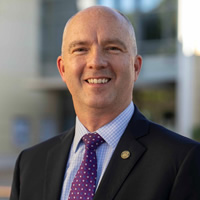
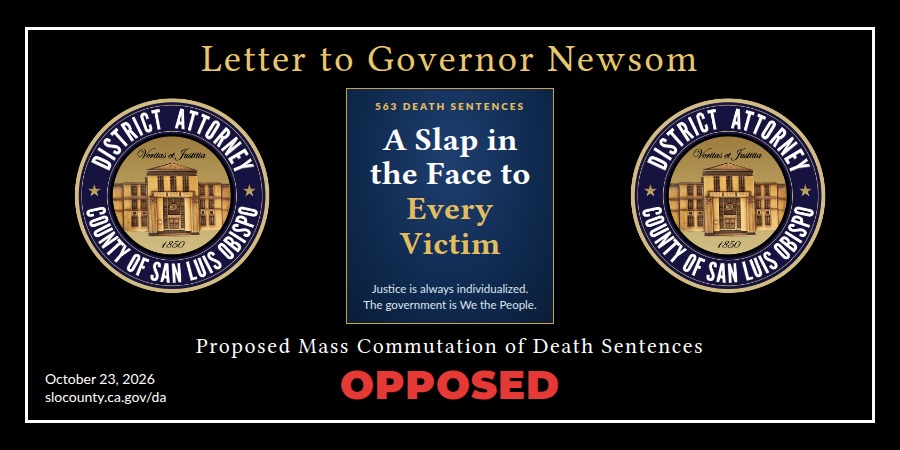
District Attorney Dan Dow announces that he has sent a letter to Governor Gavin Newsom urging him to reject a blanket commutation of all 563 death sentences in California, and to name the victims in every clemency decision he makes.
District Attorney Dan Dow announced today that he sent a letter to Governor Gavin Newsom asking him not to commute every death sentence in California. Dow, the Immediate Past-President of the California District Attorneys Association (CDAA), wrote in support of CDAA's statewide letter and separately on behalf of victims and their families in San Luis Obispo County.
"A blanket commutation would be a slap in the face to every special-circumstance murder victim and the loved ones they left behind," said District Attorney Dan Dow. "Justice is always individualized. It depends on the particular facts and circumstances of each crime, each defendant, and each victim. In our criminal and victim justice system, every victim deserves to be treated equally, and always fairly, with dignity and respect. The government of California is We the People, not one person overruling the voters in every capital case at once."
In his letter, Dow explains that every death sentence in California required a first-degree murder conviction, at least one special circumstance found true beyond a reasonable doubt, and a separate penalty phase in which a jury weighed the aggravating and mitigating evidence and chose death. Each sentence was then reviewed by the trial judge and sent on automatic appeal to the California Supreme Court. A single order commuting all of them would set aside hundreds of individualized judgments without examining the facts of even one.
Dow also reviewed the 57 clemency grants the Governor issued on October 22, 2026. Twenty-one of the 30 commutations involved a person who was killed, and 17 reduced a sentence of life without the possibility of parole. Each grantee is named, along with his or her age, education, and prison programming. Not one of the 57 grants names a single victim. Dow asked the Governor to name the victim in every clemency decision, noting that Marsy's Law guarantees victims the right to be treated with fairness and respect for their privacy and dignity, and declares that they are entitled to finality in their criminal cases.
Two men sentenced to death in San Luis Obispo County would benefit from a blanket commutation.
Rex Allan Krebs was a career violent felon. He was convicted of felony grand theft in Idaho in 1984 and sent to prison, and in 1987 he was convicted in San Luis Obispo County of violent felonies, including rape and first-degree residential burglary with great bodily injury. He was paroled in September 1997. In November 1998, he kidnapped, raped, and murdered Cal Poly student Rachel Newhouse. In March 1999, he kidnapped, raped, and murdered Cuesta College student Aundria Crawford, 20. A jury returned a verdict of death for each murder, and a unanimous California Supreme Court affirmed the judgment in 2019.
Michael Whisenhunt had already served a prison term for a violent felony firearm offense when he tortured and murdered 19-month-old Kesha Gurke in Paso Robles in 1995. A jury found the torture special circumstance true and returned a verdict of death, and a unanimous California Supreme Court affirmed the judgment in 2008.
Because both men have more than one felony conviction, the California Constitution does not allow the Governor to commute their sentences unless the California Supreme Court reviews each case and recommends it, with four justices concurring (Cal. Const., art. V, § 8, subd. (a)). In his letter, Dow wrote that the Constitution itself demands individualized review in these cases.
Dow also noted that California voters have supported the death penalty each time they have been asked: they restored it in 1972, expanded it in 1978, rejected repeal in 2012 and again in 2016, and on the same 2016 ballot voted to make it work more efficiently. He wrote that clemency is a safety valve for the individual case whose facts cry out for mercy, not a tool to repeal a law the People have repeatedly refused to repeal.
In the letter, Dow asks the Governor to reject any blanket commutation; to consider any clemency application on its own facts, with notice to the district attorney and the victim's family and a meaningful opportunity to be heard; and to name the victim in every clemency decision. He also offered to meet with the Governor or his staff, together with the families of these victims, before any decision is made.
Members of the public who wish to share their views with the Governor may do so at gov.ca.gov/contact or by calling (916) 445-2841.
Here is a copy of the letter to Governor Newsom.
Members of the media may contact Assistant District Attorney Eric J. Dobroth at 805-781-5819 for additional information.