
Key Permitting Requirement for New Ground Disturbance - Los Osos Habitat Conservation Plan (LOHCP)
The LOHCP provides a pathway for infill development and new construction for residential, commercial, community, and public infrastructure projects that are currently on hold because of potential harm or “take” to the listed threatened and endangered species in Los Osos such as Morro Bay kangaroo rat, Morro shoulderband snail, Indian knob mountainbalm, and Morro manzanita. Participating in the County’s Community-wide Incidental Take Permit provides new development and construction projects that will cause ground disturbance an opportunity to offset potential habitat destruction by following applicable measures to avoid, minimize, and mitigate (by purchasing habitat mitigation credits) take/impact to the protected species and by obtaining a Certificate of Inclusion (COI).
Steps to obtain a Certificate of Inclusion (COI)
Development Request Form (DRF)
To request habitat mitigation credits, the property owner or designated agent must submit a Development Request Form (DRF). The DRF must be submitted via email to the LOHCP Coordinator at [email protected].
*DRF can only be submitted for projects with land use permits that are “accepted for processing” or that only require the building permit process
DRF application must include:
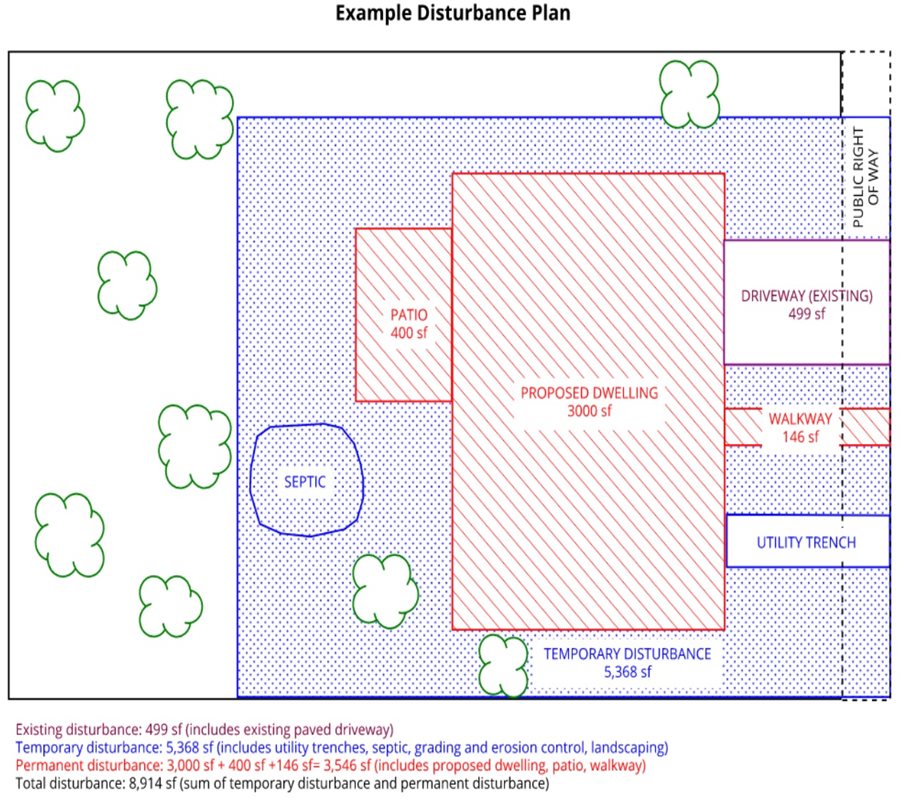
1. Site disturbance plan containing detailed information of total proposed site disturbance (see example below). Total proposed site disturbance is equal to new permanent disturbance (such as structures, decks, hardscaping and driveways) and temporary disturbance (such as grading, landscaping, fire mitigation, trenching for utilities, construction staging areas).
2. Biological visual survey targeting LOHCP species (survey no older than 1 year for species discussed in Table 5-2 and Table 5-3 of the LOHCP) performed by a qualified Biologist. List of qualified Biologists, as discerned by the County: Qualified Environmental Consultants - County of San Luis Obispo
3. Construction plans clearly showing the location and square footage of the structures, proposed hardscaping, and driveways. Note: utility, erosion, grading, and landscaping plans may be required to evaluate the total ground disturbance.
4. Water and sewer (except for on-site septic systems) continue-to-serve letter (for existing service) or intent-to-serve letter (for new service) as applicable for new construction.
If the application is deemed complete by the LOHCP Coordinator and habitat mitigation credits are available, the LOHCP Coordinator will issue a Credit Reservation Form (CRF) for the proposed project. The CRF functions as a temporary Certificate of Inclusion (COI) solely for the purpose of processing permit applications and includes defined expiration dates. The official COI will be granted when all applicable conditions of approval are met and LOHCP fees are paid with an issued building permit.
The CRF confirms total amount of reserved habitat mitigation credits and lists any avoidance and minimization measures (AMMs) to avoid and/or minimize take of/impacts to species discussed in Table 5-2 and Table 5-3 of the LOHCP that could influence the building permit process. The habitat mitigation credits are reserved solely for site-specific development and are not transferrable between projects.
-
- Finalize area of ground disturbance
- Add LOHCP Fees to building permit
- Add applicable conditions
Please make an appointment online at No Wait Inside - County of San Luis Obispo so our dedicated team members can provide assistance on the application intake.
For projects requiring only a building permit (no land use entitlement required) or projects with an approved or accepted for processing land use entitlement at the building permit stage:
- 45 days after CRF issuance: building permit must be submitted
- 1 year after CRF issuance: building permit must be ready for issuance
- 30 days prior to building permit issuance: applicant must pay LOHCP fees and meet all applicable conditions
At this point, the building permit is issued and habitat mitigation for anticipated ground disturbance resulting from a project is formalized and the project may break ground!
FAQs
In a typical year, habitat mitigation credits become available to project applicants throughout the calendar year on a first-come, first-served basis.
At that time, the project applicant may email a complete Development Request Form (DRF) along with all required documents to: [email protected]
DRF applications will be evaluated for completeness and processed in the order of complete applications received. Credits will be awarded based on availability.
Any project that results in new ground disturbance, including removal of vegetation or soil, is required to avoid, minimize, and mitigate potential take/impact to habitat. The LOHCP permit area (which includes most of the urban area of Los Osos) is unique as it supports several endemic biological communities within the Baywood fine sands ecosystem.
Private projects, infrastructure projects, and community projects that result in new ground disturbance are all required under the LOHCP to avoid, minimize, and mitigate ground disturbance.
The table below provides a detailed breakdown of the way that habitat mitigation credits are allocated and the annual timeline for mitigation credit allocation.
| January 1st | Private Development (50%) |
Undeveloped Parcels (75%) |
Residential (90%) |
Waitlist (75%) |
October 1st |
Collective Credit Pool On October 1 each year, all remaining mitigation credits in all categories will be pooled together and placed into a single credit pool. Credits will be available to any project requiring a COI and mitigation credits and will be allocated on a first come first serve basis. |
| Not on Waitlist (25%) |
||||||
| Commercial (10%) |
||||||
| Developed Parcels (25%) |
||||||
| Infrastructure Projects (40%) |
General Infrastructure Projects (50%) |
|||||
| Water Basin Infrastructure Projects (50%) |
||||||
| Community Projects (10%) |
||||||
When habitat mitigation credit availability is limited, property owners are strongly encouraged to review the strict timeframes and reservation requirements needed to secure credits for development in Los Osos.
For the May 1st, 2026 habitat mitigation credit release, approximately 55,000 habitat mitigation credits were made available from a habitat restoration project successfully completed by the County. The available credits were distributed between private development, infrastructure projects, and community projects.
As of September 17, 2026, thirteen projects have received habitat mitigation credits. Projects include single family homes, guest houses, additions, water and telecom infrastructure, and emergency septic and electrical work. Six projects have received a Certificate of Inclusion (COI) and been issued building permits.
All habitat mitigation credits that were available in 2026 have been reserved by project proponents participating for coverage under the County’s Community-wide Incidental Take Permit. Check back in December 2026 for updates about credit availability.
References:
Los Osos Habitat Conservation Plan files listed below:
Los Osos Habitat Conservation Plan (LOHCP)
LOHCP Appendices
LOHCP EIR
LOHCP IAMMP
LOHCP ITP
Los Osos Development Request Form (DRF)
Project Contacts
Comments and questions regarding the Los Osos Habitat Conservation Plan or Growth Management Ordinance may be submitted via email to [email protected] or mailed to the following address:
Department of Planning & Building
976 Osos Street, Room 300
San Luis Obispo, CA 93408