
Kratom Health and Safety Information
Learn more about kratom and 7-hydroxymitragynine (7-OH) use, health risks, safety considerations, and resources for treating kratom use disorder
About Kratom and 7-OH
Kratom is a naturally occurring herbal substance with stimulant- and opioid-like properties that is derived from a tropical tree (Mitragyna speciosa) native to Southeast Asia. It has been used as a pain reducer, sedative and stimulant. 7-OH is a natural compound in the kratom plant that has potent opioid-like properties. An estimated 1.7 million Americans aged 12 and older used kratom in 2021, according to the Substance Abuse and Mental Health Services Administration’s National Survey on Drug Use and Health.
Over the past several years, kratom and 7-OH products have become more prevalent in retail outlets and online, often mis-labeled as something other than a food, drug or dietary supplement, or marked "not for human consumption."
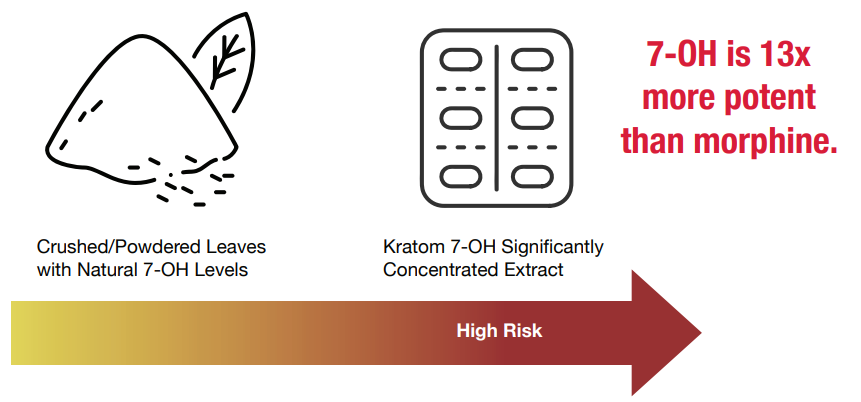
Manufacturers manipulate the 7-OH compound to create "enhanced” or “spiked” kratom products. Such products may appear to be natural leaf but can contain as much as 500% more 7-OH than would be expected naturally. 7-OH can be 13 times more potent than morphine.
Kratom, and 7-OH, acts on opioid receptors in the brain similar to how traditional opioids (e.g., fentanyl, heroin) do. Kratom products sold in stores (like gummies, candies, powders and drinks) have much higher amounts of 7-OH than naturally occurring kratom, making these products dangerous, and sometimes life-threatening.
Health Risks
Kratom products are often labeled as "natural" or "herbal" supplements, but "natural" does not mean safe. While kratom has been marketed as a natural way to boost mood and energy and treat anxiety and pain, it is actually a potent opioid (similar to prescription opioid medications or heroin) and using it can cause serious risk to one's health.
Kratom can cause mild side effects including nausea, vomiting, constipation, jitteriness, dizziness, drowsiness. Higher doses of Kratom use can cause severe health problems including seizures, coma, high blood pressure, abnormal heartbeat, liver problems, and overdose. People who use kratom regularly are likely to develop dependence (or a substance use disorder).
People who are kratom dependent and stop using Kratom are likely to experience opioid withdrawal (2024). Overdose when using kratom products can happen, especially when used in combination with other drugs or alcohol. Kratom overdoses should be treated as opioid overdoses. In the event of an overdose, administer naloxone, and immediately call 911.
Prevention Is Key
- Avoid buying any products with kratom or 7-OH.
- When buying candy or other treats for you or your family, carefully read the packaging and label so you don’t accidentally buy a treat containing 7-OH.
- Know the signs of overdose and carry Naloxone to reverse overdose. Free naloxone is available by mail to SLO County residents at NaloxoneNowSLO.org. In person community access sites are available as well- view Naloxone pick up locations here.
- Talk to your health care professional if you need help with opioid addiction, anxiety, mood disorders, pain, or other ailments.
Safety Tips
It is important if you are using kratom related products to follow safety guidelines, specifically if you are using other controlled substances, drinking alcohol, taking other medications, pregnant, breastfeeding, and/or experiencing a health condition. Other important safety tips include:
- Talk to your doctor or pharmacist before starting any new supplements.
- Always read the ingredients of a product before consumption.
- Secure medicines and supplements up and away from children and pets. Learn more safe storage tips here.
- Safely dispose of unwanted or expired medications by utilizing a local take back program. All pharmacies in SLO County offer a FREE disposal program by providing either a mail back envelope or in-store drop box for discarding medications.
- Because kratom has opioid-like properties, overdose can be prevented through naloxone. Naloxone (also known as Narcan) is a nasal spray medication that reverses the effects of an opioid overdose. Naloxone is readily available and free to SLO County residents. Learn how to administer and access naloxone near you.
Kratom Use Disorder Treatment
While there is no definitive guideline for the treatment of kratom dependence, treatment providers can manage kratom dependence similarly to dependence of other opioids, using combinations of medications and behavioral interventions including buprenorphine, methadone, and naltrexone. Please contact the Behavioral Health Department at 1-800-838-1381 for more information on substance use treatment options including Medication Assisted Treatment options.
Kratom Laws in California
Kratom and 7-OH are not approved by U.S. Food and Drug Administration (FDA) as a food, drug, or dietary supplement therefore is it not legal to manufacture or sell for consumption. Any food, drug or dietary supplement, and any food containing kratom or 7-OH is identified as adulterated and cannot be legally sold in California.
Call the CDPH Complaint Hotline at (800) 495-3232 to report unlawful sales of kratom and 7-OH products.
If you have questions that aren’t answered here, please contact the Behavioral Health Department or Public Health Department.
To learn more about the regulations and health affects of other substances, please visit:
• Cannabis Health and Safety Information
• Nitrous Oxide Safety Information
• Resources for Tobacco Retailers
Resources
For more information regarding the health and safety considerations related to Kratom:
FAQs
7-OH is a potent opioid made from concentrating a part of the Kratom plant. It is a strong chemical found in very small amounts in the Kratom plant. Some products sold in stores (like gummies, candies, powders and drinks) have much higher amounts of 7-OH than natural Kratom.


(Note: Images provided by the FDA. These images are select illustrative examples and do not represent the full scope of Kratom and 7-OH products on the market. Consumers should read packaging and labels carefully to determine whether a product contains Kratom and 7-OH)
Please contact the Behavioral Health Department at 1-800-838-1381 for more information on substance use treatment options.
- Using kratom for longer than intended
- Using more kratom than intended
- Having cravings for kratom
- Continuing to use kratom despite adverse consequences (either physically or in their personal life),
- Increasing the amount of kratom used to produce the same effect (tolerance)
- Experiencing withdrawal symptoms when kratom use was stopped (physical dependence).
These products are marketed incorrectly for recreation, stimulation, pain relief or sedation and may even be marketed as "natural" or "herbal" supplements. Despite claims that 7-OH can boost mood and energy or treat anxiety and pain, it is actually a potent opioid and is not considered safe.
Reference
| Medication Assisted Treatment |
| Overdose Prevention |
| Naloxone Now SLO |