Drought Resiliency Plan
County Compliance
As per SB 552, each county was presented with two main requirements to facilitate drought planning for water systems with fewer than 14 connections, including individual wells: the first was to establish and hold a standing drought task force, and the other was to develop a drought and water shortage resilience plan. Counties were able to establish alternative processes to meet these requirements.
The standing county drought task force was created similar to the DRIP Collaborative for the state, which provides opportunities for coordinating and communicating with the state and other local governments, community-based organizations, local water suppliers, and local residents on a regular basis. The County of San Luis Obispo met this requirement by including a standing agenda item to report on drought planning during public meetings of the Water Resources Advisory Committee.
Drought and water shortage resilience plans serve three purposes:
- present potential drought and water shortage risk for rural communities
- propose interim and long-term drinking water solutions to said risk, and
- identify available funding sources and necessary plan implementation steps
The County has completed the drought and water shortage resilience plan requirement by a combination of Drought sections of the Multi-Jurisdictional Hazard Mitigation Plan (MJHMP) and relevant County websites. The 2025 MJHMP Update was utilized to elaborate on necessary drought information within the MJHMP while the following County websites; County Environmental Health, SLO County Water, Public Works Projects, and County OES, provide additional information.
| SB552 Requirement | County Fulfillment | Status |
| Standing Drought and Water Shortage Task Force | County Drought Task Force (Working Group) | Complete |
| Water Resources Advisory Committee (WRAC) | ||
| County Environmental Health Well Program | ||
| SLOCountyWater.org | ||
| ReadySLO.org | ||
| Drought and Water Shortage Plan | MJHMP Section 5.3.9: MJHMP Drought Risk Assessment | Complete (Adopted by County BOS 1/27/2026) |
| MJHMP Section 6.4.6: Drought Capabilities | ||
| MJHMP Section 7: Mitigation Strategy | ||
| MJHMP Section 8.1.3: Drought Resilience Planning | ||
| MJHMP Appendix H: Stantec Drought Risk Assessment | ||
| Master Water Report Drought Risk Assessment | In progress | |
| Stantec System Consolidation Plan (SCP) | Complete | |
| County Environmental Health Well Program | Complete | |
| County Public Works Projects Webpage | Complete | |
| EmergencySLO.org | Complete |
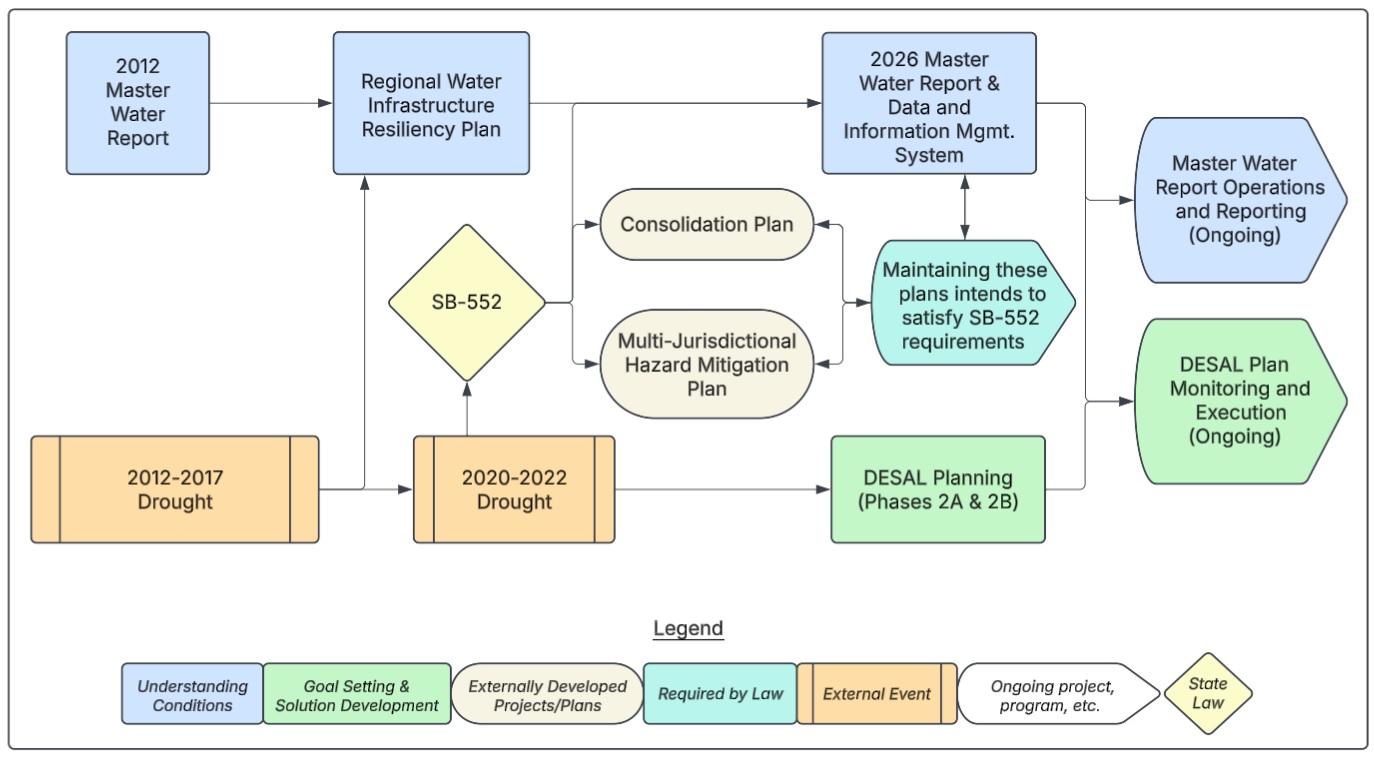
Furthermore, County SB552 efforts aligned with two other current major regional water planning efforts - the 2026 Master Water Report & Data and Information Management System and the DESAL Plan. Altogether, these efforts strive to maintain existing water sources, create new water sources, and allow for easy data transparency to the public.
Outreach:
If you have any comments or questions you would like to bring up in a public setting, please participate in a Water Resources Advisory Committee (WRAC) meeting. These meetings are the first Wednesday afternoon of every month at the San Luis Obispo Library Community Room (995 Palm Street, San Luis Obispo) and online through Zoom.
Project Contacts
For additional information, please contact Joshua Porter via email: [email protected] or phone: (805) 781-1953.FAQs
Overall, the main goals of the bill are to:
- Reduce the risk of water shortage for small water suppliers, state small water systems, and individual (domestic) wells
- Improve access to financial and technical resources
- Promote proactive planning, coordination, and collaboration
- Delegate responsibilities to counties and local agencies
All other counties have at least established their drought task forces but are working towards completing their drought resilience plan or alternative process.
The standing drought task force is led by the Public Works Department and consists of an internal working group of staff from multiple County departments and agencies. Also, the Water Resources Advisory Committee (WRAC) is being utilized as the public committee serving the task force.
The drought resilience plan has been integrated into the San Luis Obispo County Multi-Jurisdictional Hazard Mitigation Plan (MJHMP) through the 2025 update as well as existing County websites and additional produced documents. Additional documents were created by County Public Works Department and State consultant staff through direct technical assistance to fulfill remaining compliance requirements not covered by the two former methods.
- The DRIP Collaborative is the state equivalent to a county drought task force.
- The DWR Water Shortage Vulnerability Tool provides the latest data regarding drought and water shortage vulnerabilities and associated risks for counties and small water suppliers to use for SB552 efforts. DWR regularly updates the data.
- The DWR County Drought Resilience Planning Assistance Program is a hub for counties to seek essential resources for assistance with SB552 efforts. These resources range from guidance and technical assistance to financial assistance.
| Date | Presentation | Venue/Group |
|---|---|---|
| 5/29/24 | SLO County Drought Task Force Overview | California County Café Series |
| 9/23/24 | SB552 Overview | County Drought Task Force |
| 10/2/24 | County SB552 Compliance | WRAC |
| 11/15/24 | Confirmation on County SB552 Approach | County Drought Task Force |
| 3/4/25 | Stantec Collaboration with County | County Drought Task Force |
| 3/5/25 | Including SB552 into 2025 MJHMP Update | WRAC |
| 4/2/25 | Initial System Consolidation Plan | WRAC |
| 9/3/25 | Final System Consolidation Plan | WRAC |
| 12/3/25 | Summary of County SB552 Compliance | WRAC |
| 9/24/26 | Integrating Drought Resilience into Existing County Planning Efforts | DWR SB552 Symposium |