Desalination Executable Solution and Logistics Plan (DESAL Plan)
The San Luis Obispo County Flood Control and Water Conservation District (District) is working collaboratively with local partners on a 5-Phase effort to identify and, if feasible and supported, implement a local ocean desalination project. Desalination, the process of removing salt from seawater and/or brackish water to create a freshwater resource, can provide a safe, long-term, droughtproof, and resilient water supply.
As a coastal region, we have a unique opportunity to explore ocean desalination as a reliable and resilient water supply to adapt to climate uncertainties and address our region’s future water needs. With funding support from the United States Bureau of Reclamation (USBR) under a WaterSMART Grant, the District has conducted a USBR Title XVI Feasibility Study to begin exploring seawater desalination as a potential new source of water for our region.
The completed USBR TItle XVI Feasibility Study is available here:
Timeline
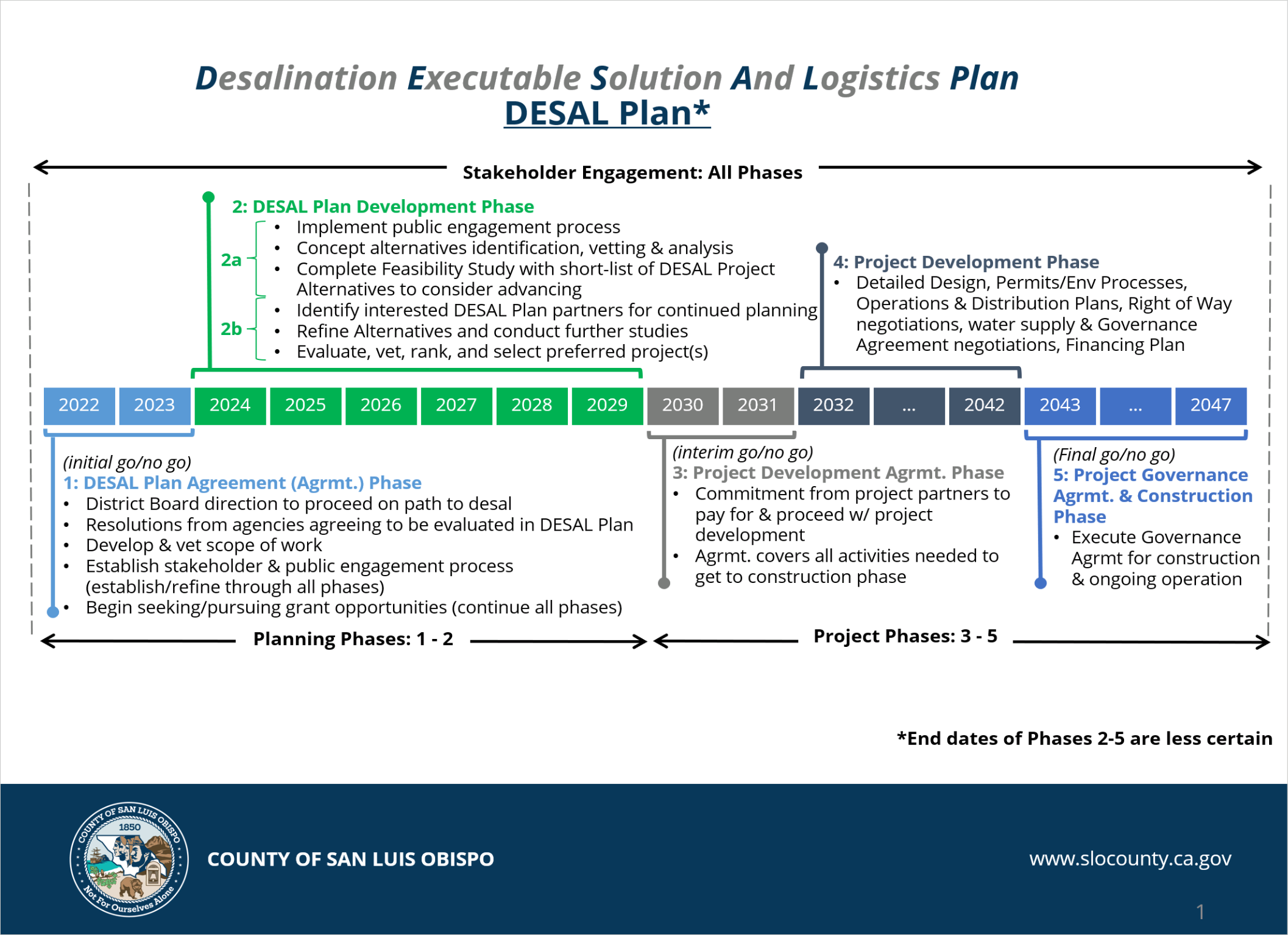
Desalination projects take decades to plan, permit, and construct. Factors that contribute to the feasibility of a desalination project include demonstrated need for the supply, permitting, funding, facility siting, community support, cultural resources and environmental protection, among others. The District has coordinated with the Countywide Water Action Team (CWAT), an informal working group of staff from entities across the County with water supply planning responsibilities, to create a 5-phased approach to develop a desalination project.
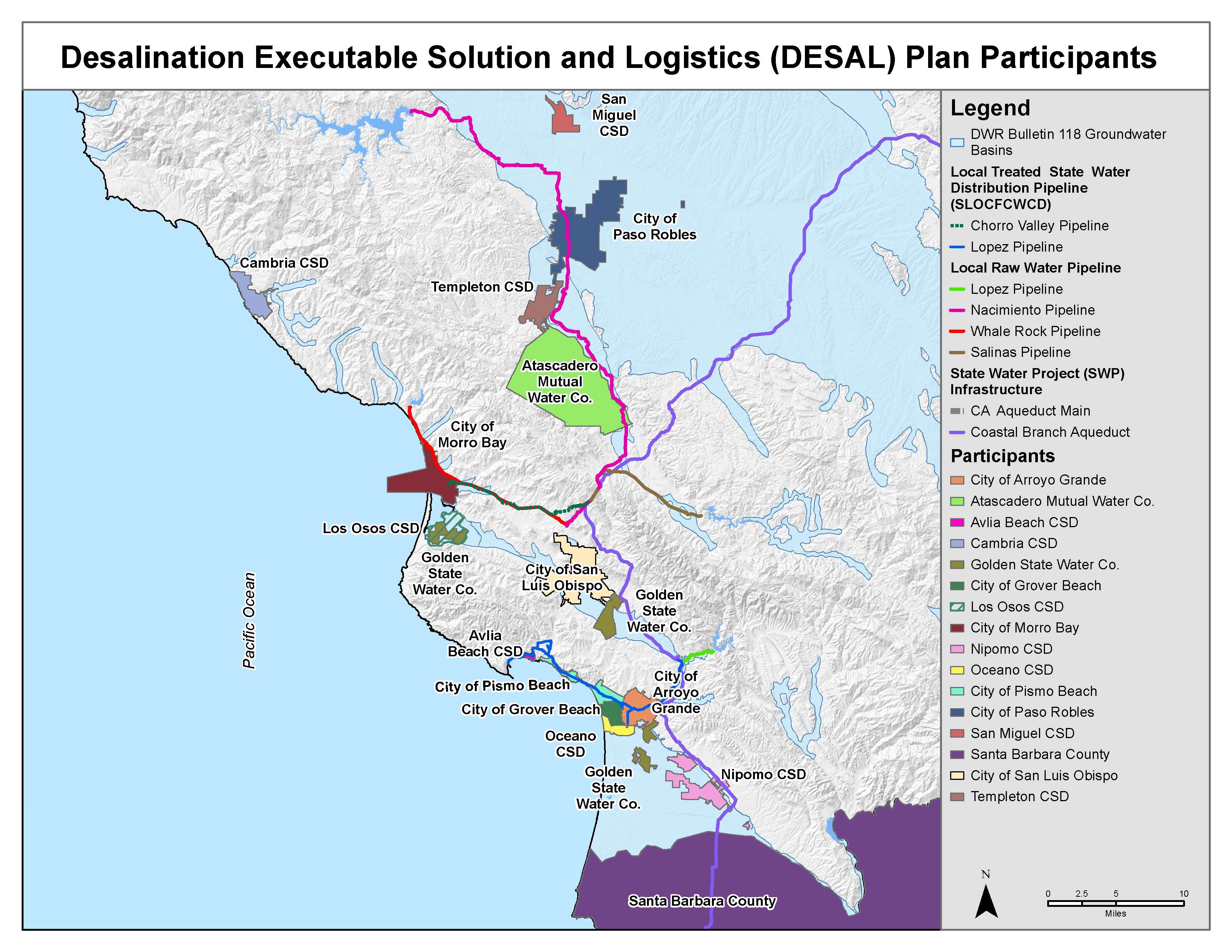
In Phase 1: DESAL Plan Agreement Phase (completed), the District worked with local agencies to confirm their interest, develop an initial planning scope, launch stakeholder outreach, and pursue funding opportunities. During this initial phase, the following agencies became DESAL Plan Partners by formally agreeing to be considered in the DESAL Plan:
- City of Arroyo Grande
- Atascadero Mutual Water Co.
- Avila Beach CSD
- Cambria CSD
- Golden State Water Co.
- City of Grover Beach
- Los Osos CSD
- City of Morro Bay
- Nipomo CSD
- Oceano CSD
- City of Paso Robles
- City of Pismo Beach
- San Miguel CSD
- Santa Barbara County
- City of San Luis Obispo
- Templeton CSD
The District and the DESAL Plan Partners are partway through Phase 2: DESAL Planning Phase. To meet the requirements of the USBR WaterSMART grant, which funds activities completed within a 24 month period, Phase 2 has been divided into Phase 2a (grant funded) and Phase 2b (to be completed later, pending funding and partner agency interest).
Phase 2a (complete), which focused on preparing a USBR Title XVI Feasibility Study (Study) to evaluate and compare desalination project alternatives was completed in September 2026. The Study evaluates potential desalination sites and conveyance options while considering environmental and physical constraints. It concludes with a short-list of five feasible project alternatives (no preferred project is selected in Phase 2a). In the Study, "feasible" means that, based on the high-level review, the alternatives are viable, technically possible and environmentally permittable; it does not mean a project has been selected or approved. Though no projects are selected and no final decisions are made in the Study, the findings will support meaningful dialogue among partner communities as we work together to help meet the region's long-term water supply goals and support a water-secure future.
Following Phase 2a, with the technical information to support future decision-making, the District and DESAL Plan partners will determine how to proceed with and fund Phase 2b. Phase 2b will require additional work such as detailed site analysis, engineering, environmental review, financial planning, and stakeholder outreach before any project can move forward.
The following is a potential timeline and description of the long-term planning 5-phases:
DESAL Plan Phase 2a Feasibility Study: Quarter 1 - 2026
As identified in the project timeline, the District completed assessments of potential locations for an ocean desalination facility. Through the investigative process, the District first identified and then evaluated several potential locations. The District and its project partners reduced the locations to five alternatives by:
- Identifying potential suitable locations
- Evaluating identified locations
- Developing alternatives through combining locations with potential users and infrastructure needs.
To identify the potential locations, the District examined areas based on hydrogeologic conditions suitable for subsurface ocean water intakes and outfalls.
The potential locations were evaluated based on technical criteria to identify areas of least potential impact to the environment and the surrounding community, outfall limitations, and the ability for a desalination facility in that location to provide water supply to the potential partner communities.
Each location was then developed into an alternative by pairing the location with potential water usage demands, pipeline routes, and desalination facility footprint.
This effort to screen locations and develop alternatives was done with input from the partner agencies as well as based on input received through the community survey, engagement session and WRAC meetings. The result was five potential alternatives identified for further study.
 Five locations/areas identified for study in the Feasibility Study
The following table shows the five alternatives that were short-listed and provides insight into some of the considerations for each. Each of these alternatives was then developed further for the feasibility study to better define supply benefits, to identify infrastructure needed and resulting impacts, and to estimate costs.
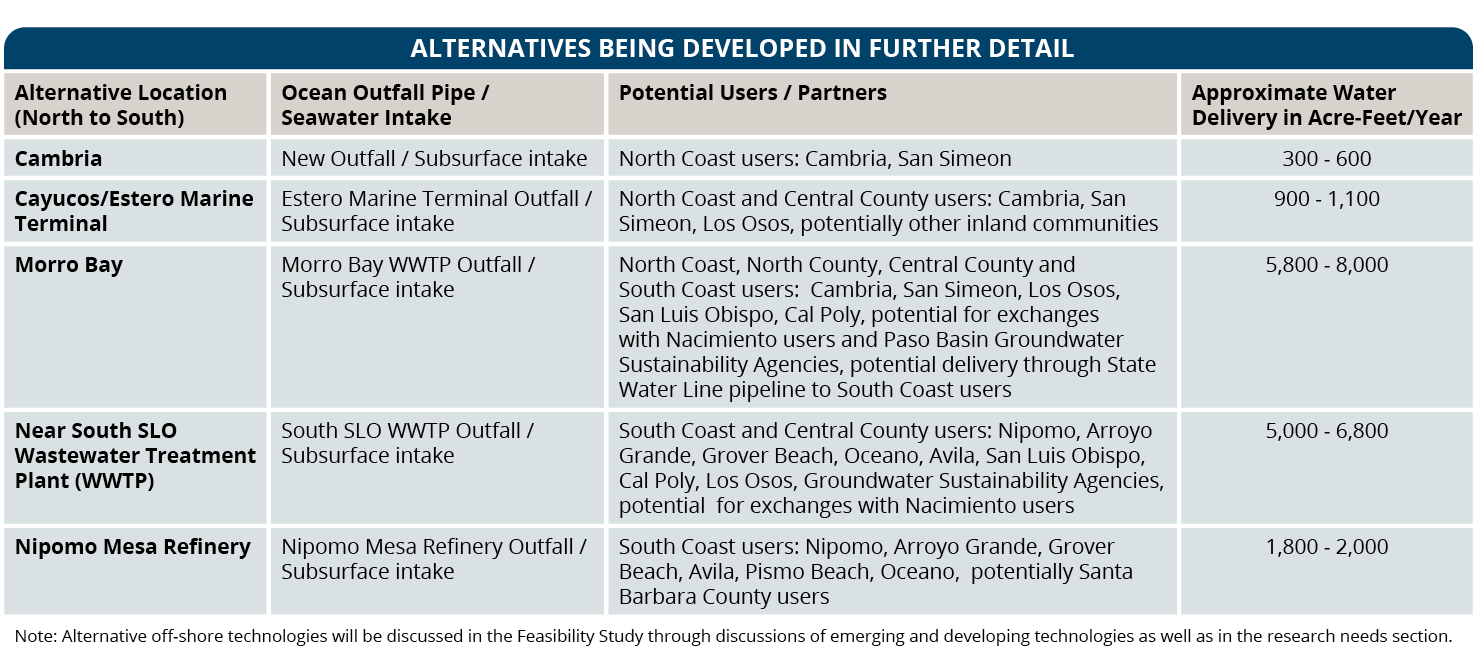 The above table lists the short-listed alternative locations in geographical order from North to South.
DESAL Plan Phase 2a Feasibility Study: Quarter 2 - 2026
The District has hosted community engagement sessions during development of the feasibility study. Two sessions were held in April 2026, one on April 20 in Morro Bay and one on April 21 in Grover Beach. The content at both sessions was the same, it was presented at two different locations to make it more geographically accessible for people to join in-person from around the county.
During these sessions, the DESAL Plan Feasibility Study team explained how potential ocean desalination concepts were being evaluated, key technical, environmental and economic considerations, as well as how desalination could fit within a broader water supply portfolio. A recording of Community Engagement Session #2 is available below.
DESAL Plan Phase 2a Feasibility Study Completion: Quarter 3 - 2026
The draft DESAL Plan Feasibility Study was released for public review from July 22 - August 7 and presented to the WRAC on August 5. The draft was then finalized presented to the Board of Supervisors to receive and file on September 1.
The Study identified and evaluated a variety of potential desalination site areas and demand scenarios, applied consistent criteria to compare them, and narrowed the options to five feasible desalination project concepts. The study follows USBR's Title XVI Feasibility Study guidance; however, it does not select a preferred project. Additional work such as detailed site analysis, engineering, environmental review, financial planning, and stakeholder outreach will be required before any desalination project can move forward.
Updates, Events and Community Outreach
Recent desalination projects within the state of California have taught us that stakeholder outreach and early engagement are critical to a successful desalination project. Meaningful engagement in the early planning phases of the project will allow us to understand the positions and needs of engaged communities, build community understanding and inform future decision making which will be necessary to obtain the required approvals to move forward any project.
Updates on the desalination planning effort will be given as part of the Water Resources Advisory Committee (WRAC) Ongoing Updates. WRAC meetings are open to the public. For meeting dates and locations, please go to www.slocounty.ca.gov/Departments/Public-Works/Committees-Programs/Water-Resources-Advisory-Committee-(WRAC).aspx.
- Recent & upcoming DESAL Plan public engagement opportunities and meeting materials are available at the links below:
- (9/1/2026) DESAL Plan Feasibility Study presented to Board of Supervisors (Board Staff Report, presentation slides, USBR Title XVI Feasibility Study Report, Appendices)
- (8/5/2026) DESAL Plan Feasibility Study presented to the WRAC (WRAC Agenda Packet, presentation slides)
- (7/22 - 8/7/2026) Draft DESAL Plan Feasibility Study and Appendices posted for Public Comment
- (6/10 - 7/8/2026) DESAL Plan Community Survey conducted
- (5/6/2026) DESAL Plan update to the WRAC (WRAC agenda packet, presentation slides, and meeting recording)
- (4/20-21/2026) In-person Community Engagement Session #2 (fact sheet, presentation slides, presentation recording, Community Engagement Sessions Summary and Responses)
- (10/1/2025) DESAL Plan update to the WRAC – Item #3: Presentation / Feedback on the DESAL Project (WRAC agenda, meeting minutes, meeting recording)
- (9/15/2025) Kickoff Virtual Community Engagement Session (video recording) (presentation slides) to inform the public about the DESAL Plan feasibility study, gather input about regional water resources, and solicit perspectives on initial feasibility study elements and ocean desalination.
- (8/25 - 9/22/2025) DESAL Plan - Public Community Survey conducted
- (6/2/2025) Final Stakeholder Engagement Plan for the DESAL Plan Feasibility Study posted
- (5/23/2025) The Key Opinion Leaders - Interviews Summary was posted
- (5/7/2025) DESAL Plan update to the WRAC –Item #4: Presentation on the Stakeholder Engagement Plan (WRAC agenda, meeting minutes, meeting recording)
- (5/2/2025) The draft Stakeholder Engagement Plan for the DESAL Plan Feasibility Study posted for public comment until 5/23/2025
- (2/5/2025) DESAL Plan contract presented to WRAC - Item #3
- (4/5/2023) DESAL Plan approach and timeline presented to WRAC - Item #7
Interested community members are encouraged to sign up for the email list (link below) to stay informed about upcoming events and milestone project updates.
Join our Mailing List
- Click here to join the County of San Luis Obispo's DESAL Plan mailing list.
FAQs
Desalination is the process of removing salt from water. There are multiple desalination technologies, however seawater/ocean desalination for potable water supplies is most commonly produced by membrane separation (reverse osmosis, “RO”). Desalinated water can serve as a new water source to meet various demand types, such as for municipal supply, agricultural/landscape irrigation, groundwater replenishment, and seawater intrusion mitigation.
In the county and across the State, existing conditions and future projections indicate that water security is declining as demands increase and available supplies and their reliability decrease.
The District has implemented / planned for water supply strategies including conservation, stormwater capture, Nacimiento Water Project optimization, Lopez Water Project spillway raise and optimization, Salinas Dam transfer and spillway raise, State Water Project and Water Management Tools, recycled water, produced water from oil extraction, and cloudseeding, to increase regional resiliency. A presentation on these efforts, provided to the District Board 2021, is available here: https://agenda.slocounty.ca.gov/iip/sanluisobispo/agendaitem/details/13094.
These efforts help maximize and extend the region’s existing water supplies, but they are not enough to provide long-term water security. Competition for existing water supplies (particularly those that depend on precipitation) in the county and across the state, is anticipated to increase with new regulations related to groundwater/surface water interactions, minimum sustainability thresholds on groundwater supplies, water quality, environmental flows, and housing directives. Relying on water sourced from precipitation from outside San Luis Obispo County (imported water) is also challenging due to the county’s relative geographic isolation, energy costs to move water long distances, and fluctuating supplies year to year. A new drought-proof, local water supply would help sustain the region’s existing and projected population. With a coastline of over 90 miles, desalination in San Luis Obispo County is a realistic opportunity.
Grants are, and will continue to be, pursued to offset project costs throughout all DESAL Plan phases. The District conducted a feasibility study as Phase 2a and it was funded in part by USBR's WaterSMART: Water Recycling and Desalination Planning grant. San Luis Obispo County’s application is available here and USBR's awards, including $548,410 to the County, are listed here.
Estimating costs associated with building and maintaining a project and how it will be funded is a part of the DESAL Plan development process. If one or more alternatives are advanced for further study, it is anticipated that participating agencies would be responsible for funding subsequent investigations, design, construction and operations, with grant funding pursued where available.
Although a seawater desalination project has the potential to be situated at a variety of locations along approximately 90-miles of coastline within San Luis Obispo County, DESAL Plan Partners will need to narrow feasible locations through careful consideration of factors such as appropriate land use, location of sensitive habitat and protected areas (e.g., marine protected areas, cultural resources), siting concerns related to the coastal zone, and proximity to power and pipeline infrastructure. The USBR Feasibility Study evaluated five conceptual alternatives at different site areas; no project location has been selected, nor have specific locations been identified.
Permitting is complex and involves multiple agencies at the local, state and federal levels. This study evaluates, at a high level, whether alternatives are likely to be permittable based on the type of criteria agencies use in their permitting review. While there is a high bar for a desalination project to get permitted, the project alternatives considered the Feasibility Study are being developed to meet known regulatory requirements and mitigation measures to increase the likelihood of being permitted.
Open intakes that were permitted and built in the past can entrain marine organisms resulting in mortality or injury. Newer subsurface intakes avoid the impacts to sensitive species because they’re located underneath the sediment of the ocean floor. Outfalls can also impact marine life due to creating pockets of elevated salinity. Measures to mitigate the impact of the discharge of brine is to mix the discharge with treated wastewater (thus diluting the salinity) and to use multiport diffusers that rapidly mix the brine with seawater in a small area. These design considerations have been built into our project alternatives as laid out by the State in the 2023 Desal Siting Streamlining Report (Water Supply Strategy Implementation: Seawater Desalination Siting and Streamlining Report to Expedite Permitting).
County board items related to desalination can be viewed at the links below:
- 9/1/2026: DESAL Plan Feasibility Study presented to Board of Supervisors to recieve and file (Board Staff Report, presentation slides, USBR Title XVI Feasibility Study Report, Appendices)
- 1/14/2025: Request to approve and execute contract with Carolo Engineers for DESAL Plan initial phase
- 4/18/2023: Resolution designating the Director of Public Works, or designee, as the authorized representative to prepare, review, approve and file an application and execute agreements for the U.S. Department of Interior Bureau of Reclamation
- 10/18/22: Resolution Authorizing Staff to Proceed with Developing the Desalination Executable Solution and Logistics Plan and Authorize the Director of Public Works, or Designee, to Pursue Grants to Offset Project Costs
- 2/15/22: Presentation by the authors of the Stanford University and Massachusetts Institute of Technology (MIT) study titled, “An Assessment of the Diablo Canyon Nuclear Power Plant for Zero Carbon Electricity, Desalination, and Hydrogen Production.”
- 11/16/21: Review and approve Fiscal Year 2022-23 Budget Goals and Policies (Water Resilience, including desalination, prioritized).
- 3/16/21: Presentation on water supply efforts in San Luis Obispo County.
- 3/22/16: Update of the Diablo Canyon Desalination Project with direction to staff to proceed with project development and coordination work, and request authorization of a corresponding budget adjustment in the amount of $900,000 from San Luis Obispo County Flood Control and Water Conservation District Reserves.
- 8/25/15: Submittal of a Desalination Opportunities Summary Report and recommended direction to staff to proceed on emergency and long-term desalination opportunities.
- Developing a Regional Recycled Water Strategic Plan
- Identifying basins requiring a Salt and Nutrient Management Plan
- Leading the development of a Salt and Nutrient Management Plans in the Los Osos Groundwater Basins (through special legislation, the County is the owner/operator of the Los Osos Water Reclamation Facility)
- Developing a characterization study of the Santa Maria Groundwater Basin as a first step to developing a Salt and Nutrient Management Plan
- Supporting the development of a Salt and Nutrient Management Plan for the Paso Robles Groundwater Basin